

Consumer unit and fuse board upgrades
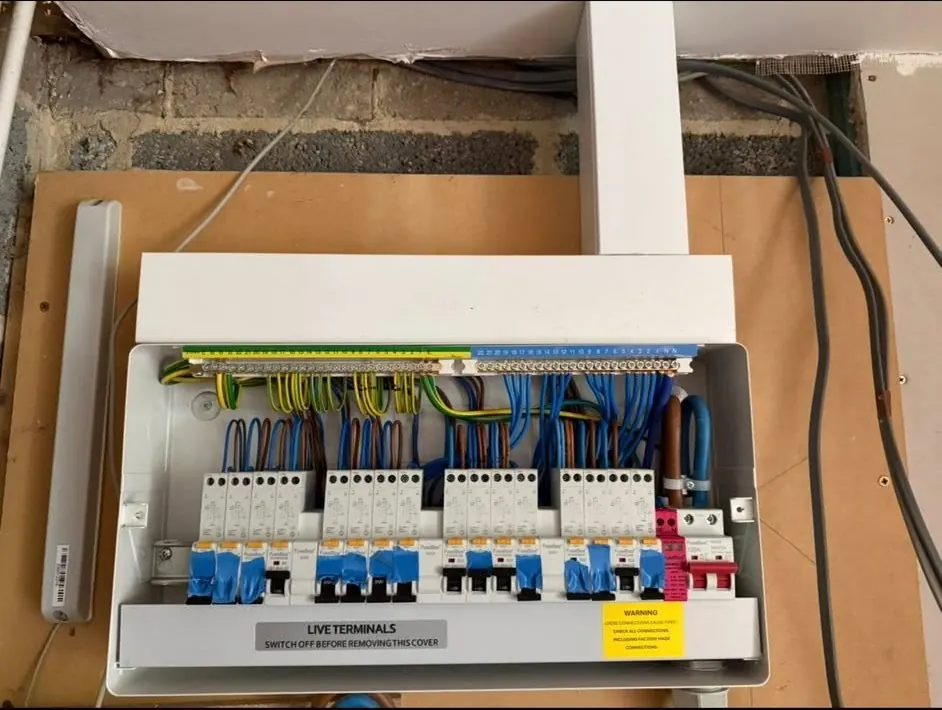
A consumer unit upgrade replaces your old fuse board with a modern metal enclosure where every circuit gets its own protection. It's usually a half-day to a day's work, and the testing at the end is as important as the board itself.
What we can help with
If your job isn't on this list, ask anyway. It's a summary rather than a limit.
- Old rewireable fuse boards and plastic units with no RCD protection
- Boards that trip and take half the house out with them
- Making room for an EV charger, a shower, a hot tub or a garden supply
- Landlord and pre-sale remedial work flagged on an EICR
- Surge protection and arc fault detection where it's worth having
When does a fuse board actually need replacing?
Age on its own isn't a reason. What matters is whether the board still provides the protection the installation needs, and whether it's in good enough condition to keep doing it.
- Rewireable fuses, the ceramic carriers with fuse wire in them. No RCD protection at all, and no way of adding it.
- A plastic board in a communal area or under a wooden staircase, current regulations call for a non-combustible enclosure in those positions.
- No RCD protection on socket circuits or on cables buried in walls.
- One RCD covering the whole house, so a fault in the garden lights kills the freezer.
- Signs of heat: browning around terminals, a smell of hot bakelite, a board that's warm to the touch.
- No spare ways, when you need a new circuit for a charger, shower or outbuilding.
What a modern board actually gives you
The practical difference is that faults get isolated instead of taking the house down.
- RCBOs. Each circuit gets its own overload and earth-fault protection, so a fault on one circuit leaves the rest alone.
- A steel enclosure, which is what the regulations require in a domestic installation.
- Surge protection (SPD), which is worth having if you've got anything expensive plugged in, boiler controls, heat pumps, solar inverters, home networking.
- Clear, permanent labelling, so the next person to open it, including you at midnight, can see what's what.
- Spare ways, so the next addition doesn't mean starting again.
How the job runs
The board swap itself is quick. The testing either side of it is what takes the time, and it's not optional. You can't certificate a board on an installation you haven't proved.
- Tests before we start, so any pre-existing faults are found before the old board comes off rather than after.
- Power off, old board out, new enclosure fitted and every circuit re-terminated and identified.
- Full testing: continuity, insulation resistance, loop impedance, RCD/RCBO operation on every way.
- Labelling, an Electrical Installation Certificate, and notification of the work under the Building Regulations.
Expect to be off supply for a chunk of the day. If you work from home or have someone who needs power, say so when you book and we'll plan around it.
What if the testing finds problems?
It sometimes does, old borrowed neutrals, a nail through a cable, damp in an outside light, a circuit with poor insulation resistance. New RCBOs are far more sensitive than an old rewireable fuse, so faults that the old board tolerated will show up.
You'll be told what's been found, what it means, and what it costs to put right before any extra work happens. Nobody likes a surprise on the invoice.
FAQs
Consumer unit upgrades, common questions
How long does a consumer unit replacement take?
Most domestic boards are a day, including the testing before and after. A larger property, a board in an awkward position, or faults found during testing can extend it. You'll know before we start.
Will my power be off all day?
Not all day, but for a good part of it. We can usually get supply back to the house before the paperwork is finished, and if you've got a freezer, a home office or medical equipment, tell us up front and we'll work around it.
Do I need a consumer unit upgrade before an EV charger?
Only if your current board can't take the new circuit, either it's full, or it can't accept the right protective device. Plenty of boards can. Where an upgrade is needed, doing it at the same time as the charger saves a second visit and a second set of testing.
Do I get a certificate?
Yes. Replacing a consumer unit is notifiable work, so you get an Electrical Installation Certificate and the work is notified through NAPIT. Keep the certificate. It gets asked for when you sell.
Is a plastic fuse board illegal?
No. The regulations aren't retrospective, so an existing plastic board isn't unlawful. New consumer units in domestic premises do have to be in a non-combustible enclosure, and a plastic board under a wooden staircase or in an escape route is worth dealing with sooner rather than later.
Related
You might also need
EICRs & inspections
Electrical Installation Condition Reports for landlords, homeowners and businesses, tested properly, coded honestly, and explained in plain English.
Read moreEV charger installation
Home and workplace charge points, installed properly: surveyed, wired, tested and certificated, with the cable run planned so it looks tidy.
Read moreRewires
Full and partial house rewires, planned around how you actually live in the place, with the disruption talked through honestly before anything comes off the wall.
Read more
Working in Uttoxeter and the surrounding area.
Get a quote for consumer unit upgrades
Tell us a bit about the property and what you need doing. If photos would help explain it, send those too.
KS Electrical · Uttoxeter, Staffordshire · NAPIT registered